


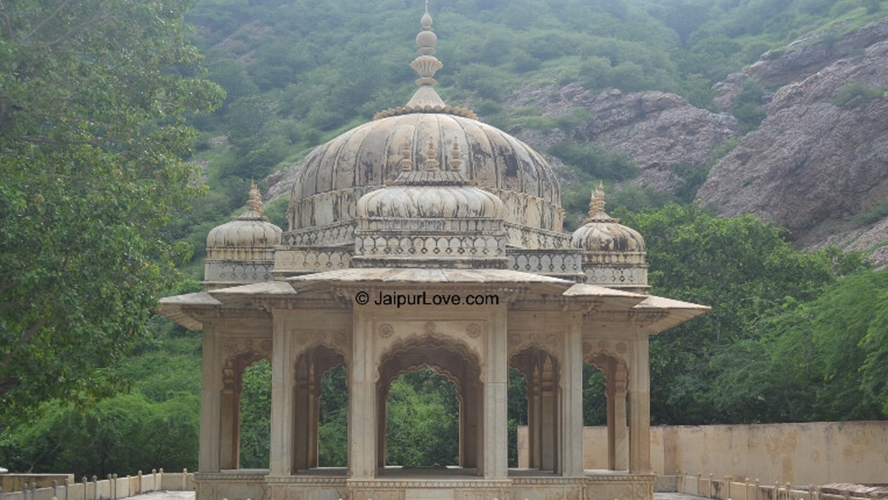
The monument has a chhatri (dome) dedicated to every ruler from Sawai Jai Singh II to Man Singh II.
About Gaitore Ki Chhatriyan Jaipur
The monument is built in the Rajput architectural style. But Mughal influence is also clearly noticeable in these. The site is famous for its intrinsic carvings on pillars and the roofs of the domes.
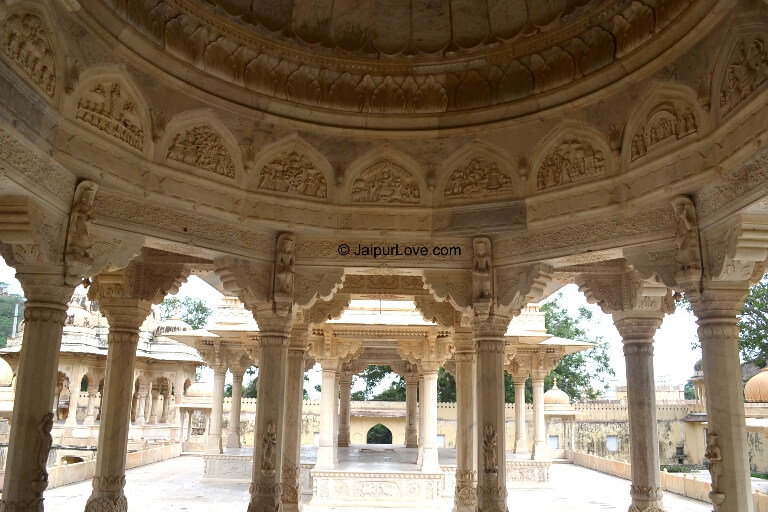
The site is divided into three parts. Stone artwork, round stairs, and depictions on the pillars commemorate the life and lifestyles of historical times.
Where are Gatore Cenotaphs?
The royal crematorium site is situated in the valleys of Nahargarh and Garh Ganesh temple. The place is surrounded by strong fort walls of Nahargarh on one side and Jaipur city on the other. It is said that Sawai Jai Singh II himself chose this site as the final resting place for Jaipur rulers.
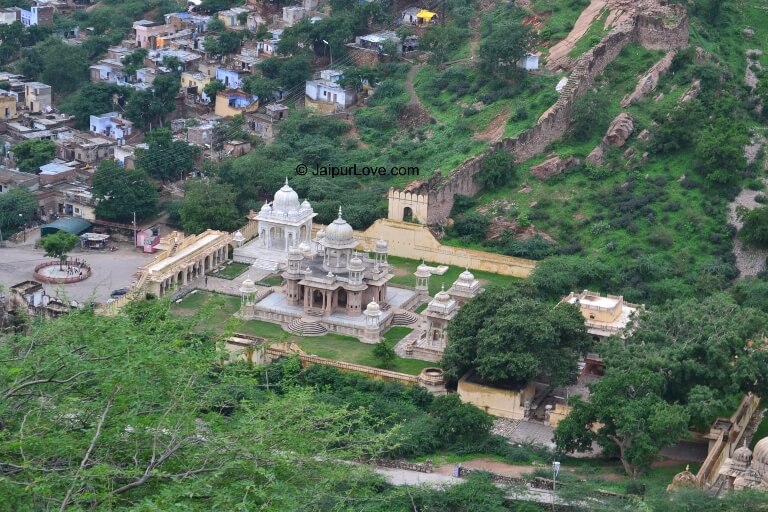
The most important thing about these structures is their location. The place is amid the Nahargarh valley. Thus, some claim it to be the most peaceful place in Jaipur.
Gaitore Cenotaph of Sawai Jai Singh II
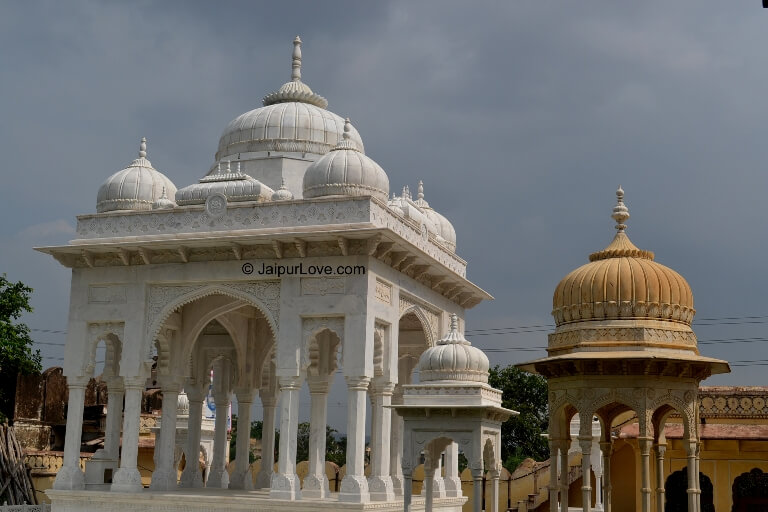
The most grandiose memorial is dedicated to Sawai Jai Singh ji. His memorial structure is made of white marble. And it is decorated with carvings of Hindu Gods, maids, musicians, and other people. It truly justifies the era of the greatest ruler of Jaipur. The dome is placed on 20 pillars.
A copy of Jai Singh’s cenotaph is also showcased at Kensington Museum in London.
A long, strong Fort wall connects Nahargarh Fort and Gaitore site. It is said that the royal family of Jaipur used the safe passage to reach Gaitore from Nahargarh fort.
Jaipur Gaitore Cenotaphs Timing
The Gaitore Chhatriya opens at 9:30 AM and closes at 5:00 PM. The ticket window is closed by 4:30 PM in the evening.
Gaitore Ki Chhatriyan Entry Ticket
| Gaitore ki Chhatriya Ticket | Indian Tourist | Foreign Tourist |
|---|---|---|
| Adult | 40 | 100 |
| Children (5-12)/Student | 20 | 50 |
| Senior Citizens/ Defense Personals / Specially Abled | 30 | 90 |
Gaitore Cenotaphs entry fees include a camera and a small video camera.
Note – Entry for children below 5 years is Free.
Things to do around Gaitore ki Chhatriya
The historic Garh Ganesh temple is adjacent to the monument site. Therefore, we recommend combining these two in a trip. Here is a list of other places of interest with their respective distances from Gaitore, Jaipur.
- Nahargarh Fort (12.1 Kms via Amer Road)
- Hawamahal (4.4 Kms)
- City Palace (4.4 Kms)
- Kalki Temple (3.8 Kms)
- Isarlat (3.5 Kms)
How to reach Gaitore ki Chhatriya in Jaipur?
The site is very well connected to other parts of Jaipur by Taxi, cabs, and autos. But direct bus service is not available to the royal site.
However, you can take a drop at Brahmapuri, and then the cenotaphs could be reached by walking a hundred meters.
We recommend you rent a Bike in Jaipur to reach Gatore ki Chhatriya and avoid narrow roads, traffic jams, and parking hassles.
Here is a list of the nearest Bus Stand, Railway Station, and Airport with their respective distances from Gaitore Cenotaphs:
- Sindhi Camp Bus Stand (5.8 Kms)
- Jaipur Railway Station (8.3 Kms)
- Jaipur International Airport (14.8 Kms)
FAQs about Gaitor Cenotaphs
Q. What is the meaning of Gaitore?
A. Gaitore refers to the royal cremation ground of the Kachwaha Rajput rulers of Jaipur. The name is believed to come from the phrase “Gaye ka Thor,” meaning “the resting place of the departed,” symbolizing the final resting place of the royal family.
Q. What is the history of Royal Gaitor Jaipur?
A. Royal Gaitor in Jaipur is a historic royal cremation site where the cenotaphs (chhatris) of Jaipur’s former Maharajas were built. The site was mainly developed during the 18th and 19th centuries after Jaipur was established by Maharaja Sawai Jai Singh II. Each cenotaph features intricate marble carvings and reflects the Rajput architectural style.
Q. Is photography allowed at Gaitore?
A. Yes, photography is generally allowed at Gaitore Ki Chhatriyan in Jaipur. Visitors can take photos of the beautiful cenotaphs and architecture, though carrying professional equipment may require an additional fee or permission.
Q. Why were these cenotaphs built?
A. Deceased kings were cremated with due royal honor. And cenotaphs were built in their memory.
This was all about this lesser-touristy place. Connect with us to plan your journey and stay in the Pink City.


Tony Coombes 11 Jan 2019
Wasn’t aware about the story of Gaitore Ki Chhatriyan Jaipur. I went there for a photoshoot though.
Pawan 12 Jan 2019
Glad you went through the Gaitore Ki Chhatriyan Jaipur story and will share it with your peers.